The Yacht Buyer's Guide Series: Part 7 — Yacht Survey and Trial Run

Updated: Sep 11
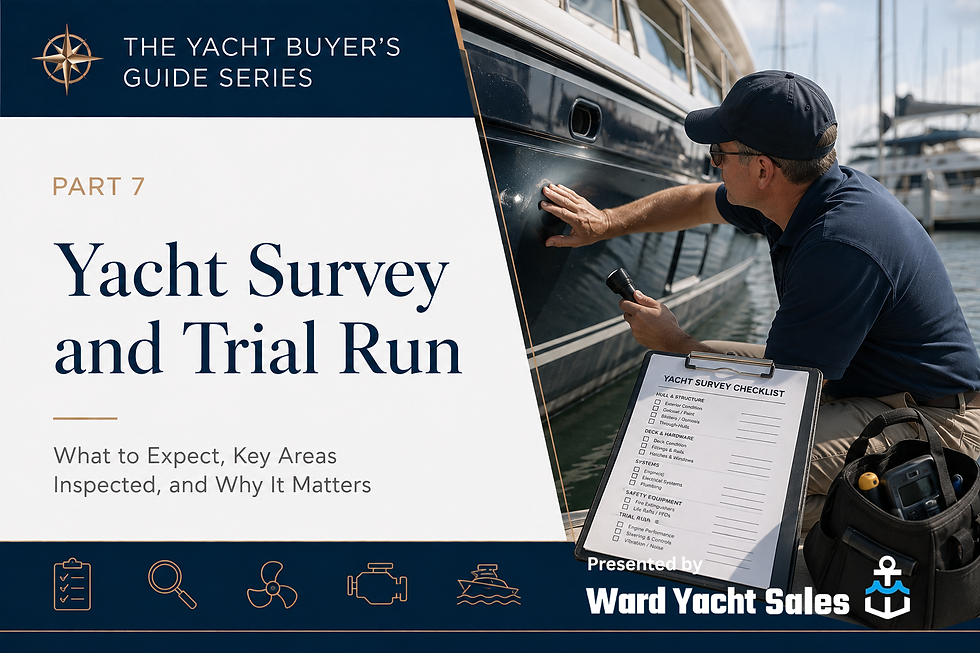
The Yacht Buyer's Guide Series by Ward Yacht Sales
This is Part 7 of Ward Yacht Sales' blog post series walking buyers through every stage of a yacht purchase, from budgeting to the first year of ownership:
Yacht Survey and Trial Run (this post)
Closing on a Yacht Purchase
The First Year of Ownership
The Yacht Survey and Trial Run
In Part 6, we covered why buyers may need to negotiate twice: once on the opening offer, and again after the survey comes back. This post is about that second step. What actually happens during a pre-purchase survey and trial run, who's involved, what the findings mean, and how to walk away with real information instead of a stack of jargon you don't know how to interpret?
If there's one step in the buying process that most directly determines whether you end up happy with your purchase a year later, it's this one. Everything up to this point: the budget, financing, insurance, negotiation strategy — has been about preparing to buy the right boat. The survey and trial run is where you actually find out, with a higher degree of confidence, what boat you're buying.
"Sea Trial" vs. Trial Run: A Clarification Worth Making Upfront
You'll often hear the term "sea trial" used in yacht sales, and it's worth clarifying. That phrase can sometimes lead to a misunderstanding. "Sea trial" may conjure images of an extended offshore passage — hours underway, testing the boat in difficult sea conditions, pushing it the way you might on an actual cruise.
That's not what's happening here. What buyers should expect is better described as a trial run: a short, controlled outing — typically an hour or two, but often less — conducted in protected or semi-protected local waters, with the specific purpose of confirming that engines, systems, and handling perform as expected under normal operating conditions.
This is NOT a shakedown cruise, not a stress test in rough water, and not an evaluation of long-range seaworthiness. The focus is narrower and more practical: verify that what you're buying actually runs, steers, and operates the way it's supposed to and within spec.
Bottom line: don't show up for the trial run expecting to push the boat to the limits for an extended period offshore or in any weather. Don't be surprised when the trial run is shorter and calmer than the often interchangeable phrase, "sea trial" might imply.
What the Survey Actually Covers
A pre-purchase marine survey is a structural and mechanical evaluation of the vessel, typically split into a few distinct pieces depending on the boat:
Pre-Purchase Hull Condition and Value Survey. This is the core report — hull and bottom condition, structural integrity, deck and superstructure, moisture readings, through-hull fittings, safety equipment, all major systems, engine and running gear, deck level hardware, and an assessment of fair market value. This is the report your lender and insurer will most commonly require, and the one most buyers mean when they simply say "the survey."
Short Haul. This is part of the pre-purchase hull survey and involves hauling the boat out of the water temporarily, usually for about an hour, so the surveyor can inspect the bottom of the boat, check thru-hulls, running gear, thrusters, keels, daggerboards, and the general bottom condition of the boat.
Mechanical inspection. Often conducted separately by a marine mechanic or engine-specific technician rather than the primary pre-purchase surveyor — particularly important on larger or high horsepower vessels. This covers engine compression, oil analysis, running gear, generators, and other propulsion and mechanical systems in more depth than a general hull surveyor typically goes. Ask your pre-purchase surveyor if he/she offers any of these services.
Rigging survey (for sailboats). A separate, specialized inspection of the mast, wire or rod standing rigging, chainplates, running rigging, and related hardware — are usually performed by a rigger rather than the general pre-purchase hull surveyor, since rigging failure is one of the more serious and less visually obvious risks on an older sailing yacht. Most pre-purchase surveyors will not inspect any rigging above deck level. If you're buying a sailboat, don't assume the general survey covers rigging in the depth it deserves; ask for this inspection specifically.
Note: surveys and inspections are the responsibility of the buyer and are non-refundable.
At Ward Yacht Sales, we encourage buyers to conduct a thorough evaluation of the vessel. These surveys are typically a condition of the offer and acceptance. That said, not every survey requires all of these steps. A newer boat with a straightforward mechanical package may not need a separate mechanical inspection; an older cruising sailboat almost always benefits from a dedicated rigging survey. Your broker can help advise which combination makes sense for the specific vessel you are considering— but the decision of what the report actually finds is entirely the surveyor's, not the broker's, which brings us to the next point.
Separation of Duties: Why the Broker Doesn't Do the Surveyor's Job
This distinction matters enough to state plainly: your broker's role is logistics, not evaluation.
A good broker helps schedule the survey and trial run, coordinates access with the seller or listing broker, helps arrange haul-out if needed, and is often present to help you understand what a finding practically means once the report is delivered. What a broker should never do is try to influence what the surveyor finds or how they characterize it.
Surveyor impartiality is the entire point of the exercise. A surveyor's value comes from being a disinterested third party with no financial stake in whether the deal closes — unlike the listing or selling broker, who will only be compensated if the sale goes through. This is also exactly why you, not the seller and not the listing broker, should be the one selecting the surveyor. A buyer's broker (see Part 6) may be able to recommend several qualified names, but the final choice — and the survey contract — should be yours.
Why Accreditation Matters: and Isn't Really Optional in Practice
Here's a detail that surprises a lot of first-time buyers: marine surveying is largely unregulated in the U.S. There's no government license required to call yourself a boat/marine surveyor. In practice, that makes third-party accreditation the primary signal of competence and accountability in the industry — and it's not just a nice-to-have.
Most major lenders and insurance underwriters explicitly require a Condition and Value survey to be authored by a surveyor accredited through one of the two main professional bodies. Hire an unaccredited surveyor, and you risk having your report rejected by the very lender or insurer you need it for — meaning you'd pay for a second survey anyway. Also, while they can often be informative, you can't use even a recent survey report that was ordered in another buyer's name.
The two organizations that matter most in the U.S. market:
SAMS — Society of Accredited Marine Surveyors, based in Jacksonville, Florida, and internationally recognized. Its top credential, Accredited Marine Surveyor (AMS), requires a minimum of five years of active surveying experience, a written exam in the surveyor's area of accreditation, and ongoing continuing education to maintain the designation. SAMS has been designated by the U.S. Coast Guard as an Accepted Third Party Organization. You can search SAMS' directory of accredited surveyors by location directly on their site.
NAMS — National Association of Marine Surveyors, whose Certified Marine Surveyor (CMS) designation likewise requires a minimum of five years of professional surveying experience and passing a discipline-specific exam. NAMS surveyors are organized by specialty — including yachts and small craft — and by region, with members across the U.S., Canada, the Caribbean, and beyond. NAMS also maintains a searchable directory to help buyers find a certified surveyor in their area.
Before you hire a surveyor, confirm their current accreditation status directly on the SAMS or NAMS site rather than taking a business card or website claim at face value — accreditation lapses, and continuing education requirements exist precisely because standards evolve.
How to Read Survey Findings: Not All Deficiencies Are Equal
A completed survey report can run dozens of pages, and the language is written with precision — which means it's easy for an inexperienced reader to either panic over something routine or breeze past something serious.
Most professionally structured reports organize findings into priority tiers, commonly along these lines:
A or First priority safety findings. Issues that represent a genuine risk to personnel or vessel safety, or that violate federal regulation — items like non-functioning safety equipment, exposed wiring, or structural concerns. These are generally expected to be addressed before the boat is used, and most insurers will require them resolved before binding coverage.
B or Secondary priority findings that need timely attention. Items that don't pose an immediate safety risk but affect compliance, longevity, or value if left unaddressed — worth a real conversation with the seller, but not automatically deal-breakers.
C or General findings, notes, and observations. Lower-priority and cosmetic items — the kind of wear-and-tear findings present on nearly every used boat, addressed in the ordinary course of maintenance rather than as a condition of sale.
A few phrases worth understanding precisely, since surveyors write carefully and the wording carries real meaning: "evidence of moisture" means readings suggest further attention is warranted, not that structural failure has occurred. "Unable to inspect" simply flags an area the surveyor couldn't access — not a clean bill of health, and worth asking about directly. "Appears serviceable" means the item looked functional on visual inspection, not that it was tested or is new.
Findings will occur on 99.99% of boats, even new boats. You should expect some findings. What matters more than any single finding is the severity level and the pattern across the report. Multiple examples of poor workmanship or deferred maintenance across different systems tells a story — one about how the boat has actually been cared for, which matters more than any individual line item.
When Survey Findings Become Grounds for Renegotiation
Back in Part 1 of this series, we talked about budgeting for the true cost of ownership — and the survey is often where that budget meets reality. A survey creates a very convenient snapshot in time of the condition of a boat and a punch list of items that should be addressed.
If the survey and trial run reveal something that wasn't previously known or disclosed — a moisture-compromised deck, rigging near the end of its service life, an engine with compression readings well below expected, undisclosed prior damage — this is squarely within the territory covered in Part 6: material new information uncovered by survey is standard, well-recognized grounds for a second round of negotiation.
This isn't an adversarial move, and experienced sellers and listing brokers expect it as a normal part of the process. Depending on the severity and category of the finding, that renegotiation can take the form of a price adjustment, seller-funded repairs prior to closing, a survey allowance/ credit, or — for serious first-priority findings — a legitimate basis to walk away from the deal entirely by rejecting the vessel, provided your purchase agreement's survey contingency was properly structured going in.
Frequently Asked Questions
What's the difference between a sea trial and a trial run? "Sea trial" is common industry language, but the actual event is typically a short, controlled outing in protected or semi-protected waters — often an hour or two — meant to confirm normal engine and system operation, not an extended offshore passage or performance stress test.
Do I need a separate rigging survey for a sailboat? Often, yes. A general marine survey doesn't always evaluate rigging in the depth a dedicated rigging surveyor does, and rigging failure is a serious, sometimes non-obvious risk on older sailing vessels. Ask specifically whether rigging is included or needs to be scoped separately.
Why does surveyor accreditation matter if surveying isn't a licensed profession? Because the industry is largely unregulated, third-party accreditation through SAMS or NAMS is the primary signal of a surveyor's competence and standards compliance. Most lenders and insurers explicitly require a survey from an accredited surveyor before they'll finance or bind coverage, making accreditation a practical necessity, not just a credential.
Can my broker recommend a surveyor? Yes, and a good buyer's broker often will — but the final selection and the survey contract should be yours, since surveyor impartiality is the entire value of the exercise, and the surveyor should have no financial stake in whether the sale closes.
Can I renegotiate after the survey? Yes, provided your purchase agreement includes a survey contingency, which is standard practice. Material findings not previously known or disclosed are widely recognized grounds for renegotiating price, requesting seller-funded repairs, negotiating a closing credit, or in serious cases, walking away from the deal.
Up next in the Yacht Buyer's Guide Series by Ward Yacht Sales: Closing on a Yacht Purchase — documentation, lien searches, funds transfer, and what actually happens on closing day.
Ready to schedule a survey and trial run on a boat you're considering? Contact Ward Yacht Sales — we can help you negotiate the best deal using comps and actual sold boat prices, manage contracts and escrow, coordinate logistics, and connect you with SAMS- and NAMS-accredited surveyors in your area. Browse our inventory of over 3,600 used yacht listings at wardyachtsales.com/yachts-for-sale or contact us today.


Comments