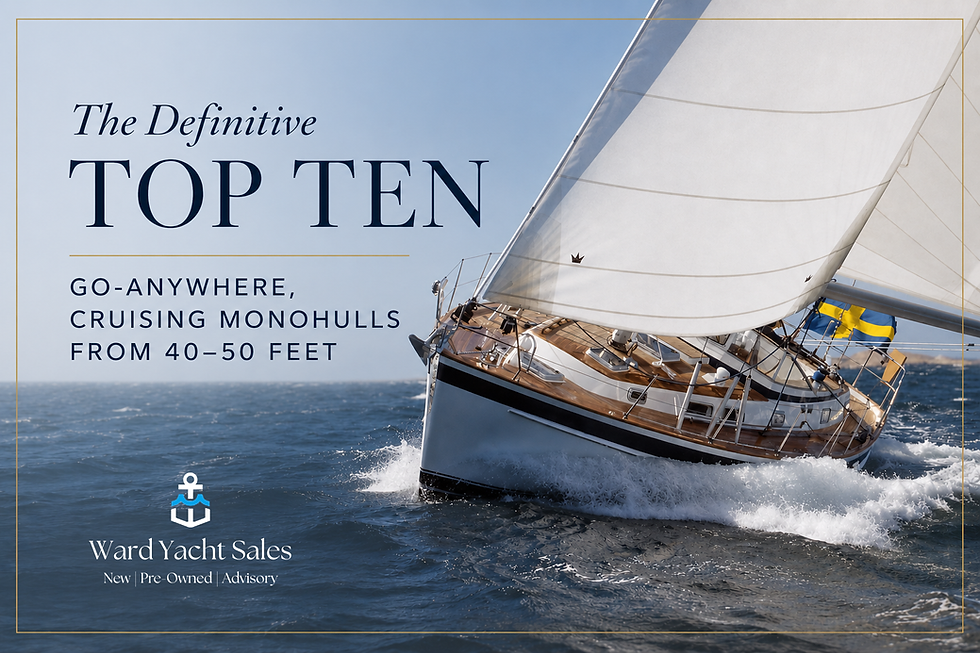
The Definitive Top Ten, Go-Anywhere, Cruising Monohull Sailboats from 40–50 Feet
Published: May 2026 | Category: Bluewater Sailing · Ultimate Guide
Est. 7–10 min read · Monohulls · 40–50 ft · Production & Semi-Custom
For the couple or small family looking to go cruising full time, these are the top cruising monohull sailboats that the world's most experienced sailors have trusted to carry them practically anywhere.
There is a particular kind of sailor—maybe you're one of them—who studies the anchorages of Martinique and the shoal drafts of the Bahamas with equal intensity, who has read Lin and Larry Pardey, Eric Hiscock, Joshua Slocum, and maybe a dog-eared copy of The Capable Cruiser. For these sailors, who are something of a dying breed, a sailboat is not a weekend toy. It is a home, a mode of travel, and a commitment to a self-sufficient life on the sea. Therefore, this boat must be handsome enough to love, able enough to trust in all conditions, and built to endure.
The golden era of serious bluewater cruising monohull sailboats—roughly the mid-1970s through the early 2000s—produced a remarkable collection of designs and innovations in cruising boats designed for voyaging. Shaped by a combination of offshore racing experience, informed by thousands of miles of ocean passage-making, and built during a period when American, European, and Taiwanese yards prioritized hand layup and honest scantlings, these boats stand in stark contrast from more modern, cookie-cutter production sailing monohulls.
What follows is a curated list of what I believe to be ten of the finest bluewater cruising monohulls between 40 and 50 feet that a couple or small family can find, afford, and trust to take them practically anywhere. Since more than 70% of the earth's surface is covered by water, that makes for a lot of possibilities!
The basic criteria: we will start with boats with genuinely handsome lines—because you will have to look at this boat every day and a tremendous amount of your time and resources will be committed to its care. Next are boats with excellent offshore sailing characteristics, having exceptional build quality and finish, a well-respected design pedigree, the kind of cockpit and interior livability that a couple or a small family can share and enjoy, and boats that have proven to hold up well and retain their value.

#1 - Hallberg-Rassy 42 · 44 · 46 · 48 · 49
The Swedish standard against which all others are measured.
Builder: Hallberg-Rassy from early 1970s - Present
Designer: Christoph Rassy/ Germán Frers
Number of Hulls: ~8,000+ hulls across the range
Origin: Ellös, Sweden
Build: GRP, hand laminate
Rig: Sloop / Cutter
Best for: World cruising couples
If you ask any gathering of experienced bluewater cruisers to name the one production sailboat builder whose reputation suffers no serious challenge, the answer is almost always the same: Hallberg-Rassy. The yard at Ellös has been producing offshore cruising yachts since the early 1970s under the guidance of Christoph Rassy, and the philosophy has remained consistent across decades: deep, protective cockpits with high coamings, center-cockpit layouts on larger models offering superb sea-keeping and an aft stateroom of real comfort, and a hull form that tracks honestly and heaves-to with grace. Germán Frers is arguably the best known, and best respected designer of our time. Since 1989, all Hallberg-Rassy boats have been designed by Frers — making theirs one of the most enduring exclusive design relationships in production sailing history.
The 42, 44, 46, 48 and 49 each represent the same ideal refined across LOA. Interiors are finished in teak with a warmth and precision of fine furniture-making. The joinery meets corners cleanly. The hardware is invariably Selden or Lewmar with thoughtful placement for shorthanded sailing. A Hallberg-Rassy cockpit in a North Atlantic gale offers protection that center-cockpit detractors routinely underestimate. These boats are not the fastest racers, but they are safe, capable, extremely handsome, and—crucially—they retain their value with unusual stubbornness. The 49, in particular, represents something close to the ideal extended-passage bluewater yacht in production form.

#2 - Hylas 46 · 47 · 49
Taiwanese refinement with American offshore intelligence
Builder: Queen Long Marine/ Hylas Yachts from 1985 - Present
Designer: Germán Frers/ Chuck Paine
Number of Hulls: ~500+ hulls built across range
Origin: Taiwan, dist. USA
Build: GRP, balsa/foam core
Rig: Sloop / Cutter
Best for: Comfortable world voyaging
The Hylas series occupies a rare position in the cruising yacht world: performance-oriented design with genuine offshore build quality, produced in Taiwan by highly respected Queen Long Marine—a yard with a reputation for excellence that few Western production builders can match—and distributed and finished by Hyde Sail's American operation. The lineage of designers engaged over the decades, including names like Germán Frers and Chuck Paine, reflecting an aspiration toward both elegance and ability that runs through every model.
The 46 and 47 are center-cockpit designs offering the cruising couple a private aft stateroom of genuine comfort, a protected helm position, and the sea-keeping advantages of the layout without the slab-sided bulk that plagues lesser boats. The 49 refines the formula even further. Interiors are finished to a standard that rivals far more expensive European yards, with teak and holly soles, solid teak joinery, and hardware choices that reflect serious offshore experience. These are boats that perform well on all points of sail while carrying enough volume below to make a six-month voyage genuinely livable.

#3 - Valiant 40 · 42
The offshore thoroughbred, American-built and race-proven
Builder: Valiant Yachts from 1974 - 2010
Designer: Robert H. "Bob" Perry
Number of Hulls: ~650 hulls built
Origin: Texas, USA
Build: Hand-laid GRP, balsa core
Rig: Cutter
Best for: Ocean passage-making
Robert Perry's 1974 Valiant 40 design is one of the most influential offshore cruising hulls ever drawn. This boat made Perry the father of the modern "performance cruiser." Derived partly from the racing-oriented Ingrid design tradition but refined into something purpose-built for long offshore passages, it introduced a generation of American sailors to the cutter rig—that two-headsail arrangement that makes heavy weather sail handling so much more manageable for a short-handed couple. The underbody is a moderate fin keel with a skeg-hung rudder, offering a balance of windward performance and tracking that passage-makers prize.
More Valiant 40s have circumnavigated than we can count. Certainly more than most other designs combined. The build quality under the original Texas yard, and later iterations, was serious: hand-laid fiberglass with proper scantlings, not the production-line efficiency optimization that characterized cheaper contemporaries. The cockpit is comfortable and well-protected. Below, the interior is functional and practical rather than palatial, arranged with offshore use genuinely in mind: good sea berths, a proper nav station, a galley you can brace against. The Valiant 42 followed with improved entry options and layouts, as well as a substantial factory stainless steel bow sprit with a double anchor roller configuration. It retained everything that made the 40 so beloved with even more refinement.

#4 - Pacific Seacraft 40 · 44
Full-keel serenity, California-built with old-world discipline
Builder: Pacific Seacraft Corp from 1978 - 2007
Designer: William "Bill" Crealock
Number of Hulls: ~300 hulls built across range
Origin: California, USA
Build: Hand-laid solid GRP
Rig: Cutter/ Sloop
Best for: Long-range ocean cruising
William "Bill" Crealock designed the Pacific Seacraft series with a philosophy rooted in simplicity, seaworthiness, and the full-keel traditions he had refined over decades. The hull form—a long, fine entry softening into a full keel with an attached rudder—is one that heaves-to beautifully, tracks without complaint, and absorbs the motion of a steep sea with a gentleness that fin-keel boats cannot match. For a couple spending weeks at a time offshore, that comfort is not trivial.
Pacific Seacraft built their boats to a standard that was genuinely exceptional for production yards of the era: hand-laid solid fiberglass in an age when wet-chopper guns were increasingly common, careful attention to through-hull and hardware installation, and teak interior joinery finished with the kind of precision that has held up through forty-plus years. The 40 is arguably the purest expression of the Crealock philosophy—compact, able, and very pretty. The cabin space is quite small compared to most of the other boats on this list, due to the relatively conservative beam and freeboard. The 44 adds volume and cruising range without sacrificing the character that makes these boats so treasured. Both are among the most seaworthy yachts ever produced by an American boat builder.

#5 - Passport 40 · 47 · 50 · 51
Taiwanese craftsmanship shaped for the serious offshore voyager
Builder: Passport Yachts Inc. - King Dragon and Hai Yang Yards from 1982 - 1988; production later moved to mainland China and a new series of boats remain in production
Designer: Robert H. "Bob" Perry
Number of Hulls: ~500+ hulls built across the entire range; early models 47ft+ are rare
Origin: Taiwan, dist. Annapolis, USA
Build: GRP, balsa/ foam core
Rig: Sloop / Cutter
Best for: Extended offshore passages
Another enduring design by Bob Perry, Passport Yachts construction in the early days was overseen by Passport Yachts founder, Wendell Renken along with his wife, in Taiwan. Together, they produced a series of offshore cruising yachts that combined thoughtful American design oversight with the extraordinary hand-finishing standards that Taiwanese builders of this era brought to fiberglass construction. The Passport 40 was the range's entry point: a fine, capable, properly-offshore yacht in a size manageable for a couple. This is still a popular and accessible boat. The 47, 50, and 51 expanded the concept without diluting it. These are incredibly handsome boats with offshore sailing performance to match.
What distinguishes a Passport from lesser production boats is the quality of construction, their balance and sailing characteristics under sail, and proven offshore ability. The hulls are laid up nearly 2in thick solid fiberglass below the waterline. The deck features robust hardware properly backed and bedded, structural bulkheads properly tabbed, chain plates that are thru-bolted to knees that were glassed to the hull and accessible for inspection or removal, and below-deck joinery that reflects serious craftsmanship rather than the appearance of it. A major difference between the Passport 40 and it's larger sister ships is that the 47+ boats were built with lead for ballast instead of iron. The 47 was also available in aft or center cockpit configurations.
These are boats designed to be at sea. The cockpit layouts are practical, the sail plans manageable, and the storage generous enough for the long-haul provisions a bluewater passage demands. Passports show up consistently in circumnavigation accounts and in the anchorages of the Caribbean and Pacific for good reason. I may be slightly biased since I am the former owner of a particularly fine 1984 Passport 47 named "Koinonia," since renamed by her new owners, "We Jammin."

#6 - Norseman 447 AC · CC
Scandinavian-inspired American ocean cruiser, quietly exceptional
Builder: Norseman Yachts from 1984 - 1999
Designer: Robert H. "Bob" Perry
Number of Hulls: ~125 hulls built across range
Origin: USA (Pacific Northwest)
Build: Hand-laid GRP, balsa-cored deck
Rig: Sloop / Cutter
Best for: High-latitude and ocean passages
Robert Perry designed the Norseman 447 with the seriousness that characterizes his best offshore work—the same clarity of purpose that informed the Valiant 40 applied to a slightly larger, more voluminous cruising platform. It is also one of his most handsome, timeless designs. The name was not accidental: these were boats explicitly oriented toward capable, self-reliant offshore sailing, and the design reflects that intent in hull form, deck layout, and interior arrangement throughout.
Available in aft-cockpit (AC) and center-cockpit (CC) configurations, the 447 offers genuine flexibility for buyers. The aft-cockpit version delivers traditional cockpit space and a more conventional interior arrangement; the center-cockpit version, with its protected helm and private aft cabin, suits the couple planning multi-week passages in demanding conditions. Perry's hull form is moderate in all respects—moderate displacement, moderate beam, moderate overhangs—which translates into balanced, predictable behavior at sea. Unlike many center cockpit boats, Perry pulls off an attractive aesthetic in a way few others have.
Build quality from the original production runs was consistently good. Among bluewater sailors who have actually made passages, the Norseman 447's reputation quietly exceeds its public profile. It remains one of my favorite designs of all time.

#7 - Cabo Rico 42 · 45
Costa Rican craftsmanship with a thoroughbred pedigree
Builder: Cabo Rico Inc./ Allied Yachts from 1986 - 2009
Designer: William "Bill" Crealock/ Chuck Paine
Number of Hulls: ~350 hulls built across range
Origin: Costa Rica/ USA
Build: Hand-laid GRP, foam core
Rig: Cutter/ Sloop
Best for: Bluewater and coastal cruising
Easily some of the most handsome boats on the list. So much so that it feels a shame to have them at #7 on the list. The Cabo Rico story is an unusual one in the American sailing industry: production was in Costa Rica where extraordinary hand craftsmanship could be applied to serious yacht construction at a price point that no domestic yard could match. Sales and distribution was primarily based on Ft Lauderdale starting in 1983. The 42 and 45 are among the most beautifully finished production cruising yachts ever offered to the American market, with teak joinery that inspires genuine admiration and hull construction that is robust by any measure.
Chuck Paine's Cabo Rico 42 was offered in an aft cockpit or a pilot house and is a stunning boat with the excellent seakeeping qualities a cruising boat demands: a hull that moves well in light air, tracks reliably in trade-wind conditions, and heaves-to respectably in a blow. The cutter rig option makes offshore sail handling genuinely manageable. Below, the saloon and staterooms are finished with the kind of detail that makes a Cabo Rico immediately recognizable at any dock: the teak joinery is extraordinary, the sole bright, and the cushion work above reproach. These are boats that look and feel expensive in the best sense.

#8 - Caliber 40 and 47 LRC (and later LRC SE)
Florida-built with full-keel gravitas and cruiser-focused intelligence
Builder: Caliber Yacht Corporation from 1990 - 2010
Designer: Michael McCreary
Number of Hulls: ~175 hulls built across range
Origin: Clearwater, Florida, USA
Build: Solid hand-laid GRP
Rig: Cutter (LRC)
Best for: Liveaboard bluewater cruising
Caliber Yachts of Clearwater, Florida built something genuinely distinctive: an American production cruising yacht of the post-1990 era that maintained the construction standards and offshore orientation of an earlier generation while incorporating the space and comfort expectations of modern bluewater liveaboards. The LRC designation — Long Range Cruiser — was not just marketing hype. It was a design specification that ran through every decision in the boat, from the standard cutter rig on all models to the solid-laminate hull construction at a time when production yards were embracing coring for speed and cost savings.
The 40 LRC was the range's workhorse: a properly offshore 40-footer with a full-length keel featuring a cutaway forefoot — a hybrid form that offers the directional stability and shoal-water forgiveness of traditional full-keel designs while surrendering less to windward performance. In 2002, Caliber introduced the 40 LRC SE (Special Edition), which updated the interior layout and finish spec while keeping the hull and rig unchanged — a refinement rather than a redesign.
The 47 LRC scaled the core philosophy into a more spacious cruising platform with the same construction approach: solid glass, proper backing plates, bulkheads tabbed rather than bonded. It also featured a watertight bulkhead in the bow in the event of a collision at sea. Below, the interiors across the range are among the most livable ever fitted into boats of their respective sizes: wide saloons, galleys functional for extended passages, and forward staterooms with a pullman berth that two adults can actually share. Caliber's devoted owner community and strong resale values are the plainest evidence of all the things they got right.

#9 - Kaufman 47
A forgotten masterpiece by Kaufman & Ladd, built for discerning passage-makers
Builder: Kirie (FRA) from 1986 - 1988
Designer: Kaufman & Ladd
Number of Hulls: limited production
Origin: USA
Build: GRP, foam-cored hull
Rig: Cutter / Sloop
Best for: Serious offshore passages
The design office of Kaufman and Ladd produced work of quality that never quite achieved the public recognition it deserved. Arguably, the most famous example is "Quetzal" (pictured above) and owned by famous American offshore sailor, teacher, and author John Kretschmer. This is an offshore cruising boat through and through: a hull with moderate displacement, careful attention to stability characteristics, and an accommodation plan that expected the boat's crew to spend weeks at sea rather than weekends at the dock.
Limited production numbers mean that a Kaufman 47 in good condition is a genuine find—a boat that rewards the knowledgeable buyer who is willing to search. Teak decks being the biggest concern. Those who have owned them consistently report the same qualities: a hull that performs well in diverse conditions, a rig arrangement that makes short-handed sailing manageable, and solid construction that instills confidence on the darkest nights offshore. The limited number built also means that the buyer is investing in relative exclusive boat—a standout vessel in an anchorage of mass production boats.

#10 - CSY 44
Charter-born, passage-proven, and built for the genuine long haul
Builder: Caribbean Sailing Yachts from 1974–1985
Designer: Peter Schmitt/ Frank Hamlin
Number of Hulls: ~ 300 hulls built
Origin: Tampa, Florida, USA
Build: Heavy solid GRP laminate
Rig: Cutter / Ketch
Best for: Rugged liveaboard voyaging
The CSY 44 is a very distinctive boat that occupies a unique position in American sailing history: it was designed by Peter Schmitt specifically for the rigors of bareboat charter in the British Virgin Islands, which means it was engineered to survive a clientele that would subject it to every possible form of hard use, amateur navigation, and dock-induced violence—and to do so year after year without fail. For the serious cruiser, this origin story may sound like a funny place to start, but it's a real plus that has stood the test of time.
The result was a boat of considerable robustness: heavy solid glass construction, a full keel of sound integrity, simple mechanical systems designed for field repair in anchorages far from professional help, and an interior arrangement with extraordinary volume for a 44-footer. CSY 44s routinely have more usable cabin space than 50-footers of the same era. Initially, it was offered in a walk over configuration with a separate aft cabin accessible via the center cockpit. Later, a walk-through version (pictured above) was offered and even a rare pilothouse version. The external chainplates with round bases are very distinctive and robust.
The walk-through transom—a CSY signature—makes boarding the boat from a dinghy extremely practical. On passage, these boats are steady, comfortable, and forgiving. They are not fast, and no one who has ever seen one will mistake it for a racer, but ask a CSY 44 to take you from the Caribbean to the Azores or to the South Pacific, and it will comply without complaint.
Top Cruising Monohull Sailboats - Honorable Mentions
Four boats that nearly made the list — each are great in their own right.

Amel Super Maramu 2000
Builder: Amel S.A from 1986–2012
Designer: Henri Amel & Berret-Racoupeau
Number of Hulls: ~ 500 hulls built
Origin: La Rochelle, France
Rig: Ketch
Possibly the most controversial omission from my top 10 list. In terms of systems, the Super Maramu is one of the most thoroughly outfit production cruising yachts ever built: a center-cockpit ketch with every passage-making convenience spec'd from the factory, from in-mast furling on both masts to a factory-integrated watermaker. Amel's philosophy—reduce the crew to one person who can handle everything from the cockpit—produces a boat that is genuinely exceptional for short-handed offshore sailing. The reason it falls just short of the main list: let's face it, the Amel Super Maramu places function above fashion. Maintenance can also prove complex and expensive. A serious contender, nonetheless, particularly for the single-hander.

Island Packet 44/ 420
Builder: Island Packet Yachts from 1992 to 2005
Designer: Bob Johnson
Number of Hulls: ~ 180 hulls built
Origin: Largo, Florida - USA
Rig: Sloop/ Cutter
These full keel, aft cockpit, cutter rigged boats are extremely popular in the US among cruisers. They are capable and extremely roomy for their size thanks to generous beam and freeboard. Many IPs have sailed far and wide and the build quality is considered quite good. The biggest drawback to these boats is that the chainplates for the stays and shrouds were glassed into the hull, making inspection and replacement a major project that requires removing much of the interior. They are comfortable and forgiving under sail or in a seaway, but perform best on a beam or broad reach.

Swan 46
Builder: Nautor Swan from 1998–2006
Designer: German Frers
Number of Hulls: ~ 100 hulls built
Origin: Pietarsaari, Finland
Rig: Sloop/ Cutter
Putting a Swan on an honorable mention list just feels wrong. Pure poetry in motion. And yet, the Swan 46 sits here mostly because of its price point and racing DNA—even used—these place it in a different category from most of the boats above. German Frers designed a hull of exceptional refinement and Nautor's Finnish construction is without peer in the world of production sailboats. For the buyer who can afford to stretch their budget and wants offshore capability alongside genuine racing performance, the Swan 46 is simply one of the finest sailing yachts of its size ever built.

Beaufort 14 · 16m Ketch
Builder: Wauquiez Boats from 1974–1985
Designer: Jean-Jacques Herbulot
Number of Hulls: Limited production
Origin: Saint-Galmier, France
Rig: Ketch
Jean-Jacques Herbulot is best known in France as the designer of the Vaurien dinghy, but his larger offshore work deserves far wider recognition. I recall the first time I ever saw a Beaufort 14m. She was anchored on the west coast of Guadeloupe (pictured above). It was love at first sight! The Beaufort ketch was offered in 14m and 16m versions—is an exceptionally handsome, balanced, and capable blue-water design built during the period when French yards were producing serious offshore yachts without the budget compromises that would later characterize production sailing. Why below the line? They are exceptionally rare and underappreciated almost everywhere. However, the Beaufort rewards the knowledgeable buyer: it is one of the most elegant cruising ketches of its era, as able offshore as it is pleasing to the eye. A boat for the true connoisseur.
Conclusion
We would love to hear which cruising monohulls are on your top 10 list and how would you rank them. Let us know what you think of this list by leaving a comment below. Before you get carried away, yes, I realize I cheated by listing a range of boats for several of these makes, rather than narrowing it down to just one model. I also admit that several potentially worthy boats have been omitted. "What about (fill in the blank)???" I can think of several Able, Bristol, Gozzard, Hinkley, Mason, Tayana, etc that are great boats, but for one reason or another, these all fell short in my opinion, based on my underlying criteria. One thing I enjoy about writing articles for sailors is I can be sure they will generously share their opinions!
Perhaps, the most accurate description I know of when it comes to the ideal offshore, bluewater cruising sailboat can be summed up by this simple quote:
"The best offshore boat is the one you own, know deeply, and trust completely — provided you chose wisely in the first place."
A Sailor's Truth, Anchorage to Anchorage
lf you are in the market for a bluewater cruising monohull sailboat, contact us today and let one of our friendly, knowledgeable, licensed and bonded brokers assist you. We will conduct in-depth market analysis using broker only tools, help you search on and off-market vessels, take the lead on negotiations, inspections, trial-runs, contracts, escrow, transfer of ownership, and much more. At Ward Yacht Sales, we help our clients get the right boat for the best price. We specialize in making yacht ownership dreams a reality.
Article Written By: Ben Ward, Co-Owner/ Managing Broker at Ward Yacht Sales
Production figures are approximate and reflect best available historical records. Some yards changed ownership or ceased production; hull counts include variants within each named model series. Buyer due diligence—including professional survey and sea trial—is always recommended when purchasing any pre-owned cruising yacht.


Comments